
World Fertility
From the annual ANSZREI fertility meeting in Sydney to the international ASPIRE conference in Adelaide. Podcasts, blogs & a 'Fertile Minds' YouTube education video.


Welcome to Spring 2023 - Sept/Oct/Nov
The season for renewal.
This year has seen more fertility face-to-face events, travelling to Sydney & Adelaide to learn from Australian, New Zealand and International peers.
Ongoing collaborations have seen a podcast episode, newspaper article and a blog post created, as well as presenting at GP education evenings, where I presented an update on the 2023 PCOS Guidelines.
1. Fertile Minds YouTube (17 November 2023)
I also recorded an educational episode of ‘Fertile Minds’ on YouTube (see link below). This was a discussion of Pre-Conception Genetic Screening - to see if individuals carry hidden/recessive genetic conditions, and how we might use IVF with embryo testing to prevent genetic disease, as an option. It was a great to have a conversational style episode - please look out for more of my Fertile Minds videos coming up in the future :)
2. The Balanced Medics’ Handover Podcast (10 Sept 2023)
For Women’s Health Week, I discussed the importance of fertility planning, including the role of egg freezing as an option, to give us more time to have our families. Lovely to be interviewed by Dr Isabella, a doctor and health coach, from The Balanced Medics (listen here).
3. Sydney Morning Herald (28 June 23)
I discussed that the decision to pursue assisted reproduction should be a considered one, taking into account our pre-existing health and time frames (read here).
Dr Violet Kieu, consultant gynaecologist specialising in fertility, reproductive endocrinology, and fertility preservation at Melbourne IVF, says the first step she always takes with her patients is education.
“I educate and empower my patients to understand their fertility because we know that your lifestyle choices affect fertility. This includes diet and exercise, alcohol and smoking and endocrine disruptors which can have a negative impact on hormonal health,” says Kieu.
4. Melbourne IVF Blog (5 May 23)
I also wrote about fertility preservation options - not only egg freezing, but that for some people there may be a role for sperm and embryo freezing. For example, sperm freezing for men on active deployment or before cancer care (read here).
Australian & New Zealand Society for Reproductive Endocrinology & Infertility (ANSREI) Meeting
On 16 & 17 July 23 the annual ANZSREI Meeting was held at the Park Royal, Darling Harbour Sydney. The guest speaker was American specialist Dr Eve Feinberg, from Chicago, a Journal Editor and host of the Fertility & Sterility On Air Podcast. We were part of a live audience and livestream for a debate on Uterine Transplant and Surrogacy (watch here).
Uterine Transplant Panel
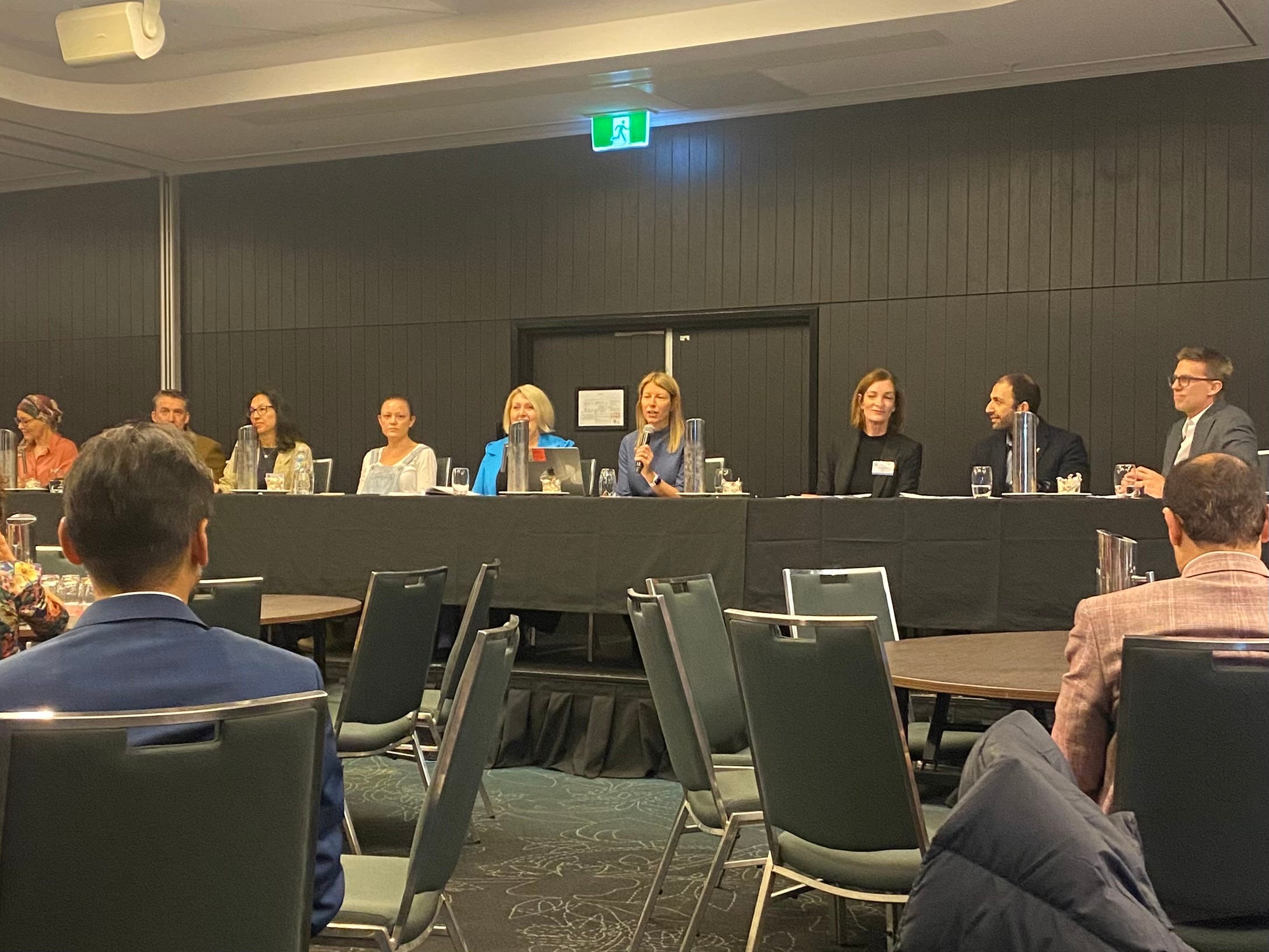
The demand for uterine transplantation was described as ‘patient driven’. Indeed, one of the guest speakers was patient advocate Prue Craven, wo stated that receiving a donated uterus was the ‘last option, not the first’.
Prue was the first uterine transplant recipient in Australia for the condition Mayer–Rokitansky–Küster–Hauser syndrome (MRKH), where women are born with an under or not developed uterus, and the third person in Australia overall to receive a transplanted uterus.
Undoubtably complex surgery, Prue described the psychological importance of a uterus to recipients. She quoted a survey of MRKH patients and stated that many respondents supported reproductive autonomy and choice, where the option of a uterine transplant would allow for empowerment over their own pregnancy.
She described her own attempts at surrogacy - an experience that it was not successful in an overseas program, and where she was unable to find a suitable local altruistic surrogate in Australia.
Now pregnant, she is the first woman in Australia with MRKH to become pregnant post uterus transplant (@makingroomforawomb).
Also, the first person to receive a uterine transplant in Australia, Kirsty Bryant, has also documented that she is too is pregnant (@myuterustransplantaus).
(Please note - at current time 2023, uterine transplants in Australia are still under a research protocol).

The Asia Pacific Initiative on Reproduction (ASPIRE) Conference
Trend of Global Population decline
ASPIRE is the Asian Pacific Initiative, where the 2023 Adelaide Conference hosted a Keynote Speaker of Prof John Aiken, author of The Infertility Trap (Cambridge University Press, 2022). He described a paradox - that we have the largest population of the world ever, but that the world’s population may actually experience a massive decline. This is given that Total Fertility Rates (TFR) are falling in industrialised countries, where TFR is the average number of children born to a woman over her lifetime. Many industrialised countries are below the population replacement values. For example, Australia’s TFR is 1.6, below the replacement rate of 2.1 children per woman.
His paper in Human Reproduction, titled the ‘Changing tide of human fertility’ 2022 stated that the ‘consequences of overpopulation is all around in the form of widespread pollution and climate change, but the demographic tide is about to turn.’ He noted by the end of this century an estimated powerful trend where a majority of 183 of 195 countries will have TFR values below population replacement rates.
Australian Population Trends
The Australian Government’s Centre for Population commissioned a report (summary here) from the Australian National University (ANU) in 2022 to explain the trends and drivers of fertility in Australia and better understand the impact of Government policies on fertility decisions.
Drivers of fertility
Macro level – costs and benefits of having children, and social norms around parenthood and lifestyle. These macro level factors are influence by policy settings, including childcare and parental leave.
Micro level - At the individual level, factors such as age, relationship status and level of education affect fertility.
These decisions all together determine Australia’s overall fertility rate.
Policies that support participation of both parents in employment through (government funded paid) parental leave and childcare (subsidy) and those that reduce the financial costs for parents were found to be important.
The University also ran a poll (ANUpol Aug 2021), investigating the top 3 factors associated with fertility decisions in Australia. These factors were:
General cost of raising children,
Security of you or your partner’s job, and
Having someone to love.
So economic factors affect our fertility decision making, but also deep intrinsic and personal factors as well.

Fertility Dietician
In fertility, we practice in muti-disciplinary teams. Celeste, from Fertility Theory, is an Accredited Practicing Dietician and Nutritionist, who also consults at our beautiful rooms in Templestowe. She has kindly contributed a guest recipe for the newsletter :)

Rainbow Salad
This salad is not just a treat for your taste buds but also a practical way to incorporate essential nutrients into your diet.
Start with a base of 2 cups of baby spinach, complemented by the creamy texture of half an avocado. Add in 2 large carrots, sliced into ribbons, and a punnet of red and yellow cherry tomatoes for a variety of antioxidants. Sprinkle half a cup of pomegranate seeds for a burst of fertility-boosting goodness and top it off with half a cup of walnuts for added crunch and omega-3 fatty acids.
The dressing is a simple blend of 2 tablespoons of extra virgin olive oil, 1 teaspoon of iodized table salt, and 2 tablespoons of either balsamic or apple cider vinegar. This combination not only enhances the flavour but also adds a great source of antioxidants and healthy fats.
Incorporate the Rainbow Salad into your routine as a delicious and practical way to ensure you are getting a spectrum of antioxidants, vitamins, and minerals. With every bite, you are nourishing your body and giving it building blocks to support conception and a healthy pregnancy.
What I’m Watching
I love fantasy and sci-fi. Lot’s of good streaming options at the moment.
Pantheon (Prime) - uploaded intelligence, human brains in the clouds. Animation, through engaging intelligent dialogue and fascinating concepts (5 stars).
Foundation (Apple TV) - cloned dynasty, a living machine, and what happens when the empire begins to falls. I think season 2 does drag a bit with the sub-plots of the ‘rebels’, but overall some satisfying revelations and insights into human decision making under pressure (4.5 stars).
Wheel of Time (Prime) - A high fantasy world, dealing with themes of re-birth, and the gender and status differences between women and men who wield the ‘One Power’ (4 stars).

What’s next - Guest podcasts, GP talks & Educational YouTube talks
Keeping up special collaborations, I will be a guest on an upcoming podcast. I aim to talk about natural menstrual cycles, fertility tracking, as well as environmental effects on sperm and egg health.
I am also committed to ongoing GP education talks & ‘Fertile Minds’ YouTube episodes - highlighting the importance of keeping up-to-date, discussing and debating the latest knowledge to drive best patient outcomes & experience.
Wishing you and your loved ones a happy & safe season.
Best,
Violet x
Information in the Freeze Fertility Newsletter is of a general nature only.
To make an appointment at East Melbourne, Templestowe or via Telehealth, please call (03) 9473 4695 or email drkieu.reception@mivf.com.au and visit www.freezefertility.com.au